
How do we measure circularity?
Part 1 - Standards, frameworks and methodologies to start measuring the circularity of your products (objectively)

Hey Sustainability Managers!
This week we are taking a break from Digital Product Passport and will tackle a question that haunts many sustainability professionals: how do we measure the circularity of a product?
If you’ve ever sat in a meeting where someone confidently declared a product “circular” because it uses some recycled content, you know the problem. Circularity is not a binary state. It’s a spectrum and measuring it requires rigor. So let’s get into it.
Unlike carbon footprint, where ISO 14064 and the GHG Protocol give us a relatively consolidated path, circularity measurement is still a landscape of competing frameworks with different scopes, assumptions and trade-offs. There is no single globally adopted standard yet, what we have is a toolkit and knowing which tool to use when is the real skill.
The good news? The toolkit is maturing fast.
ISO 59020: the new baseline
The most important development in recent years is ISO 59020:2024, published by ISO Technical Committee 323 on Circular Economy. This is the first ISO-level attempt to standardize how circularity is measured and assessed across organizations and value chains and it’s a big deal.
ISO 59020 doesn’t prescribe a single metric, instead it defines the principles any circularity measurement methodology must follow to be credible: clear system boundaries, transparent assumptions, traceability of material flows and differentiation between biological and technical resource loops. Think of it as the meta-standard: whatever indicators you use internally, they should be alignable with ISO 59020 if you want your claims to hold up under scrutiny from regulators, auditors, or procurement teams.
Expect this standard to show up increasingly in EU regulatory requirements and B2B procurement criteria over the next few years. Getting familiar with it now is a low-regret move.
During the last few weeks, we have worked for you and craft the Fashion Circularity Index, a public screening tool to quickly assess the circularity of garments (based on ISO 59010, ISO 59020, ISO 59040.
Test it at THIS LINK
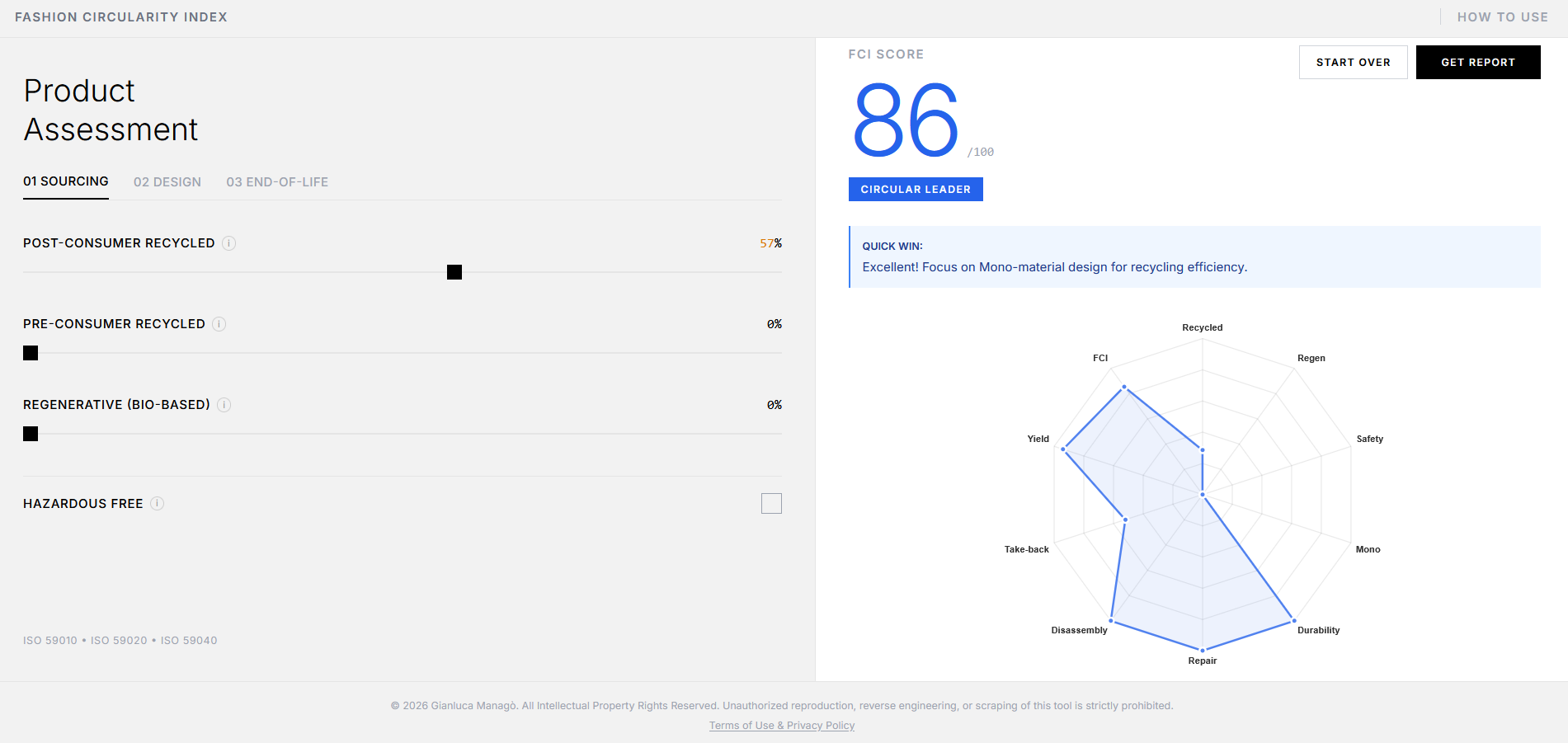
Find at the end of this email the deck I used in a recent webinar to explain how these tools are created.
Life Cycle Assessment (ISO 14040/14044)
LCA is not a circularity metric per se, but no serious circularity measurement effort can ignore it. ISO 14040 and 14044 govern how LCAs are conducted, and they provide the environmental impact data that gives actual meaning to your circularity indicators.
Here’s a nuance that trips up a lot of teams: high circularity does not automatically mean low environmental impact. A product with high recycled content scores better on circularity but if the recycling process is energy-intensive and running on a dirty grid, the climate benefit shrinks considerably. LCA is how you check whether the circular strategy you’re optimizing for actually delivers the environmental gains you expect, rather than just moving the problem upstream.
For consumer goods, the most relevant approach is a cradle-to-grave or cradle-to-cradle system boundary, with explicit treatment of the end-of-life phase. One methodological choice that significantly affects your results and that you must justify in any public claim is whether you use the cut-off approach or system expansion for allocating credits from recycling. Both are accepted under ISO 14044, but they can produce very different numbers, so document your reasoning.
Material Flow Analysis
Any credible circularity measurement starts with Material Flow Analysis (MFA), the quantitative methodology for tracking material inputs, outputs, stocks and losses across a defined system. MFA is standardized under the Eurostat Economy-Wide Material Flow Accounts framework and the OECD’s material flow accounting guidelines and it provides the empirical backbone for any circularity indicator you build on top of it.
At product level, the key MFA outputs you need are the virgin material input fraction, the recycled or reused material input fraction, the waste fraction going to each end-of-life pathway (recycling, landfill, incineration with and without energy recovery, reuse), and critically, the process losses at each transformation stage. Those losses, often called dissipative flows, are where circularity silently bleeds out and most simplified metrics ignore them entirely.
Getting this data right requires tracing material flows across your full value chain, which in practice means working with primary data from suppliers and certified waste processors rather than relying on generic databases. Imprecise end-of-life recovery rates are the single biggest source of error in product-level circularity assessments.
EN 45554: repairability and durability measurement
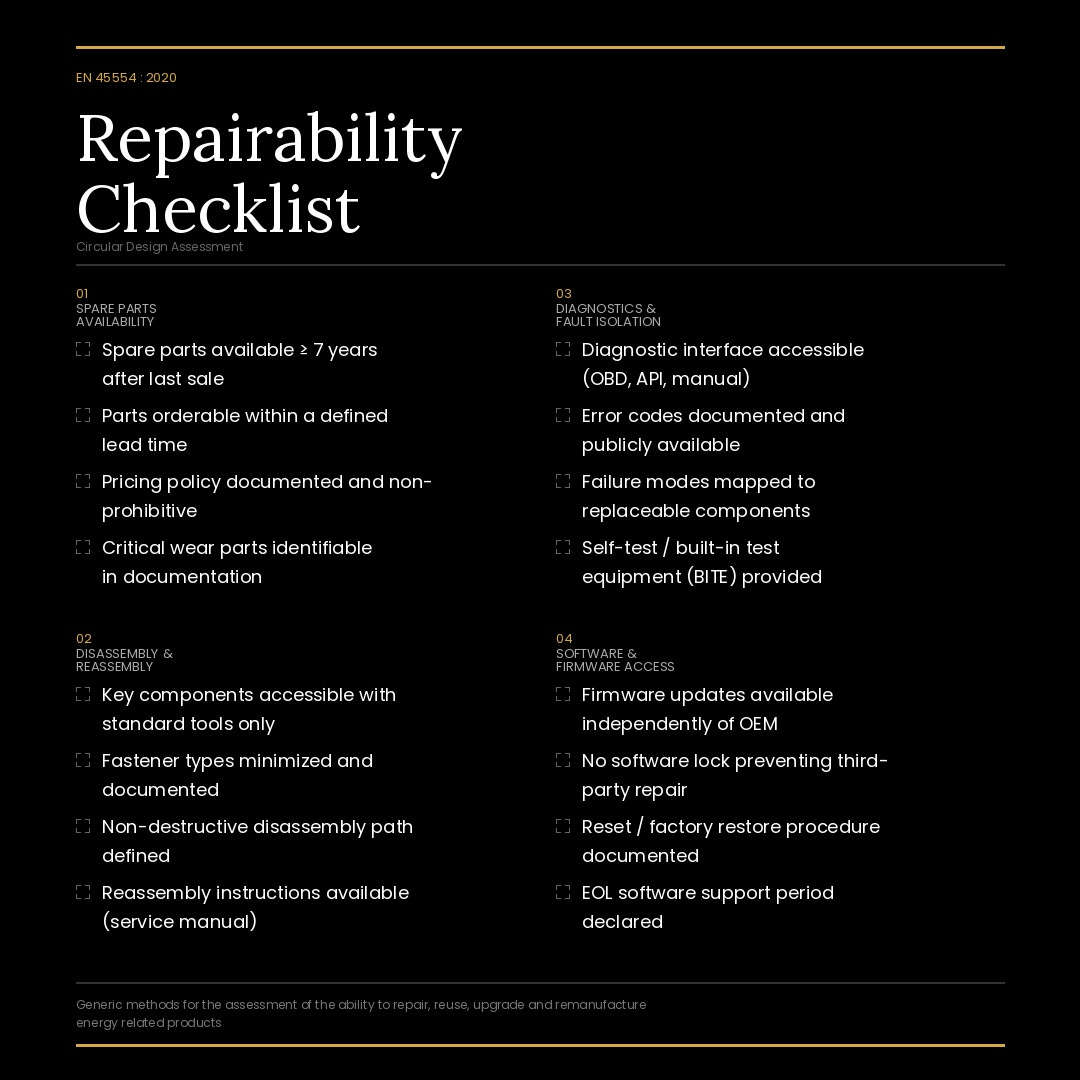
One area where circular design is measurable but frequently skipped is repairability. The European standard EN 45554:2020 provides a generic methodology for assessing the ability of energy-related products to be repaired, reused, upgraded and remanufactured. It defines scoring criteria across four dimensions: availability of spare parts and repair documentation, ease of disassembly and reassembly, availability of diagnostic tools and access to software and firmware updates.
For product engineers, EN 45554 is a design checklist disguised as a measurement standard. If your product scores poorly, that score maps directly to design decisions you can change, fastener types, modular architecture, software lock-in, spare part pricing policy. The ESPR delegated acts are expected to mandate EN 45554-aligned repairability scoring for several consumer goods categories from 2025-2026 onward, so this is not optional for much longer.
ISO 14021 and the problem of circular claims
Once you have measurement results, the next challenge is communicating them without falling into greenwashing. ISO 14021 governs self-declared environmental claims, including claims about recycled content, recyclability and extended product life. It requires that any quantitative circularity-related claim be based on verified data, use clear and unambiguous language, and specify whether it refers to pre-consumer or post-consumer recycled content, since these are very different things from a circular economy perspective.
Post-consumer recycled content, material that has gone through a full use cycle and been recovered from the waste stream, is what actually closes the loop. Pre-consumer recycled content, which is mostly production offcuts that never left the industrial system, is significantly less valuable from a circularity standpoint and should not be conflated with it in product claims.
Where this is heading
The Ecodesign for Sustainable Products Regulation operationalizes all of the above into binding product performance requirements. Product-specific delegated acts will mandate minimum thresholds and measurement methodologies for recycled content, recyclability rates, durability, and repairability across consumer goods categories, with compliance requiring documented, auditable measurement systems aligned with the standards discussed here.
The data infrastructure required to demonstrate compliance at scale is exactly what the Digital Product Passport is designed to carry. Which is, conveniently, what we’ll be getting back into next week.
How are these tool created?
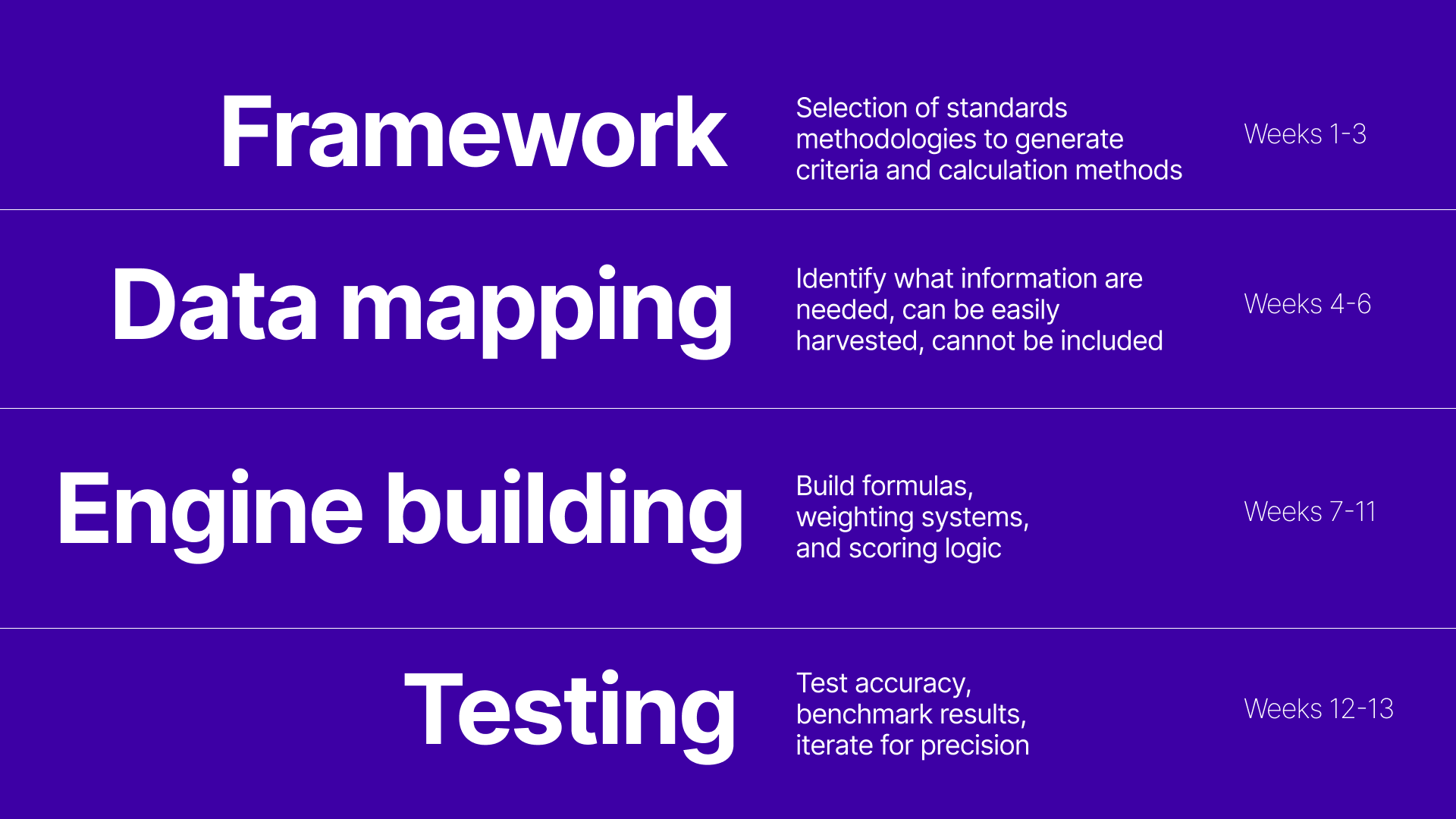
Creating a robust circularity calculator is a multi-phased engineering and data science project that typically spans 13 weeks, moving from theoretical framework selection to a refined scoring engine. The process begins by selecting standards and methodologies to establish clear criteria and calculation methods. This is followed by a rigorous “Data Mapping” phase to identify which information can be easily harvested and which must be excluded. The "engine" of the tool is then built by developing formulas and weighing systems to normalize data from disparate units, such as energy costs or material ratios, into a common 0-100 scale. For example, a criterion like energy consumption can be assigned a specific weight (e.g. 10%) of the final score, with normalization turning raw costs into a benchmarked numerical value. Finally, the tool undergoes accuracy testing and benchmarking to iterate for maximum precision.
Find the presenation I gave at a recent webinar HERE
Thanks for the ongoing support! That’s all for this week!
Best,
Gianluca
Coming up next week
Next week we will dive deeper into PART 2 of “How do we measure circularity?” with some tools and best practices to prepare for DPP. Stay tuned!
Such insightful content! It's interesting to look at the impact between pre and post consumer waste so brands can understand where to put their efforts, especially if their resources are limited