
How I built a circularity tool with Vestre
The why, the what, the how of building a circularity tool

Take a look at my website!
Dear Sustainability Managers,
Why do you even need a circularity tool?
Year one: the company tracks carbon emissions. It makes sense: carbon is visible, measurable, reportable. Everyone gets on board.
Year two: durability becomes the focus. Products need to last longer. New metrics, new targets, new conversations.
Year three: carbon is back. But now it’s scope 3 and someone added material passports and the procurement team is tracking supplier certifications and product development is running lifecycle assessments on their own.
Suddenly, the same people, sometimes the same person, are chasing 50 different parameters, in 50 different spreadsheets, with no shared definition of what “circular” even means inside their organization.
This is a story about what happens without a system.
Circularity without a tool isn’t a strategy. It’s a collection of individual efforts that never add up.
What a circularity tool actually is
A circularity tool is not a dashboard. It is not a compliance checklist. It is not another sustainability report dressed up as software.
A circularity tool is a shared language, translated into decisions.
It gives the people who design products, source materials and allocate budgets a common framework for asking the same question: does this choice keep resources in use, at the highest possible value, for as long as possible?
The answer will look different in each department. But the question needs to be the same.
When that happens, three things shift:
Coherence replaces coordination. Teams don’t need to align constantly because they’re already working from the same logic. The tool does the alignment work so people can focus on the decisions.
Circularity becomes operational, not aspirational. It moves from the sustainability team’s agenda into the daily workflow of product developers, procurement managers and financial planners. It stops being a value and starts being a practice.
The company stays relevant. As regulations tighten, customer expectations rise and supply chains face new pressures, having a functioning circular system is not a differentiator, it becomes the baseline. The companies that build the infrastructure now will not be scrambling to catch up later.
The Vestre case: building it from the inside out
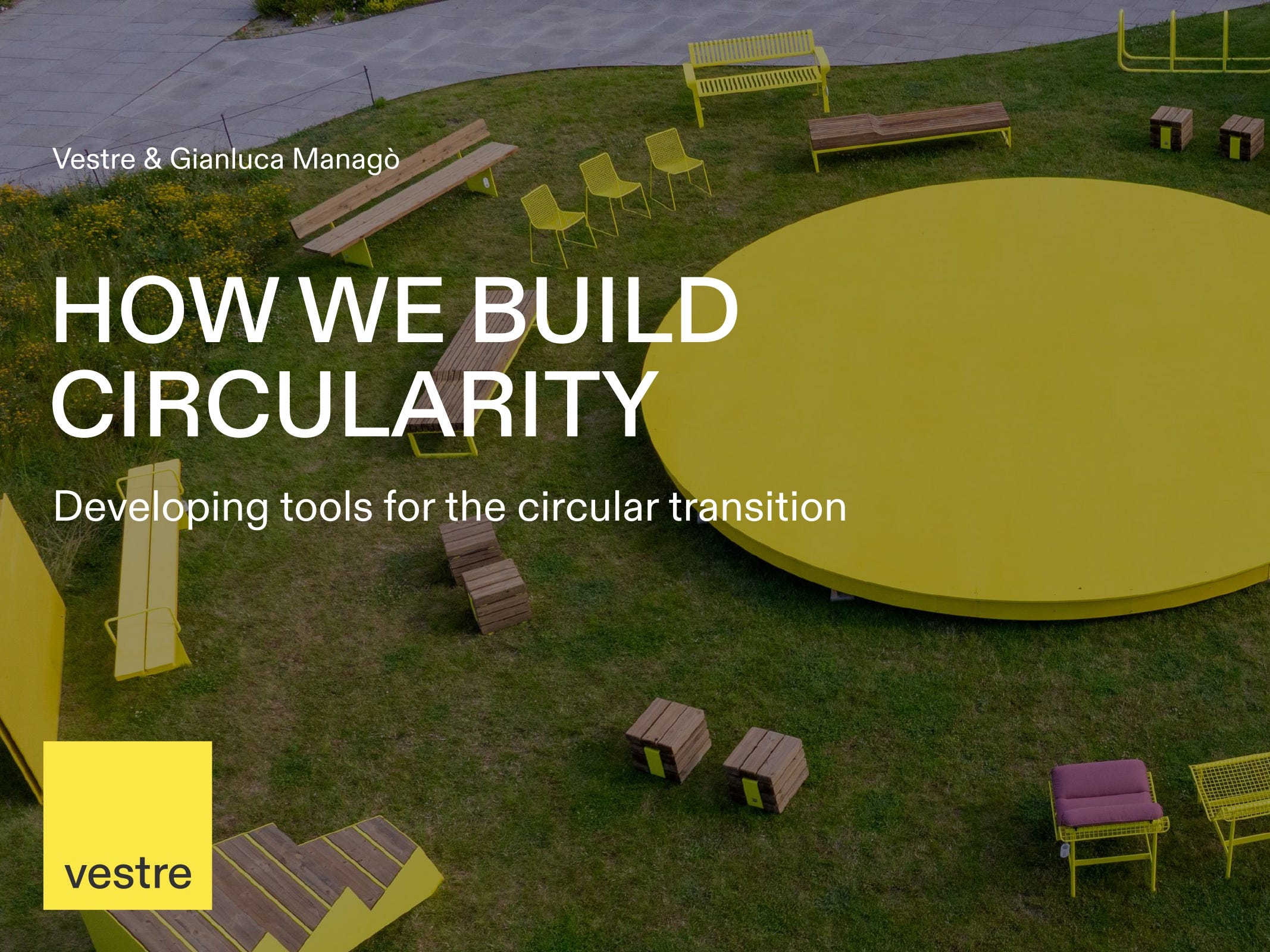
Vestre, the Norwegian company known for creating some of the world’s most sustainable urban furniture, understood this early.
For Vestre, circularity has never been a communications exercise. It is built into how the company makes things: the factories, the materials, the supply relationships. But ambition at that level requires infrastructure to match. Good intentions, without a system, will always stay intentions.
Working together, we set out to build a circularity tool that could serve the entire organization, not just the sustainability function.
The starting point was not technology. It was people.
We began by mapping how different teams inside Vestre were already thinking about circularity: what they tracked, what they cared about, where they felt the gaps. What emerged was exactly the pattern described above: deep expertise in each pocket, but limited connection between them.
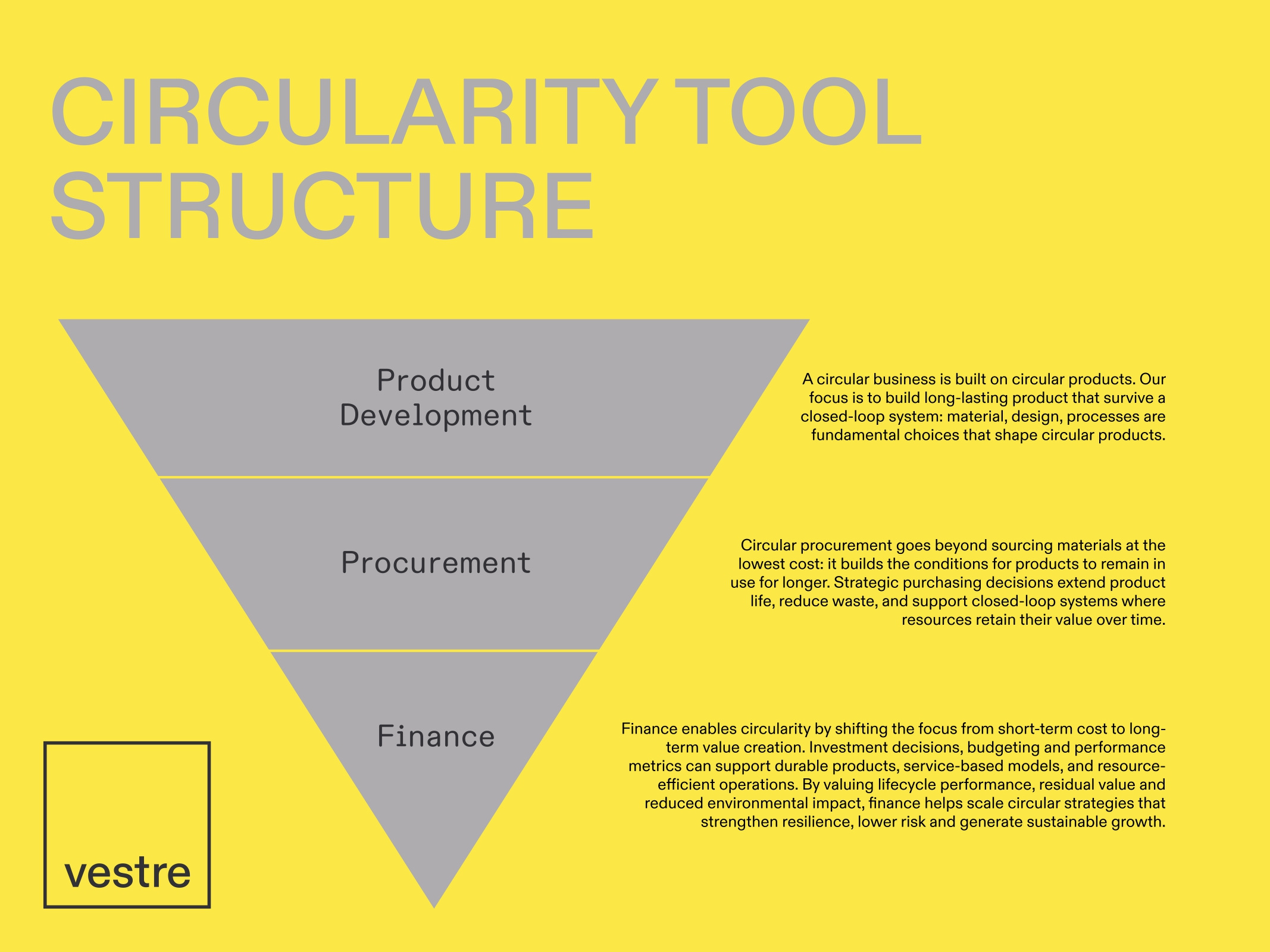
The tool we developed is structured around three interconnected domains:
Product Development
Where circular decisions are made earliest and where they have the greatest leverage. Material choices, design for disassembly, durability targets: these are the foundations of a circular product. The tool brings circular criteria into the design process itself, not as a post-hoc evaluation.
Procurement
Where circular intent either holds or collapses. Circular procurement is not about finding the cheapest input. It is about building supply relationships that extend product life, retain material value, and support closed-loop systems. The tool gives procurement teams the criteria and the context to make those decisions consistently.
Finance
Where circularity needs to be valued, not just acknowledged. When investment decisions are made purely on short-term cost, circular strategies lose. The tool helps finance teams evaluate lifecycle performance, residual value and long-term efficiency, so that the economic logic of circularity is visible before the decision, not invisible until the audit.
These three domains don’t operate as separate modules. They function as a connected system, where a decision in one area surfaces its implications in the others.
Selling the outcome, not the process
It is tempting to talk about circularity in terms of effort: the workshops, the frameworks, the research. But effort is not the outcome.
The outcome is what changes.
For an organization like Vestre, the outcome of a working circularity tool is this:
Strategic coherence. Every team, at every level, is working from the same definition of what circular means for this company. The tool makes that definition concrete and actionable, not abstract and aspirational.
Resilience. Circular businesses are, by design, less exposed to supply shocks, regulatory shifts, and material scarcity. A tool that operationalizes circularity is also a risk management tool.
Credibility. In a world where greenwashing is under increasing scrutiny, having an internal system, not just external claims, is what separates companies that lead from companies that follow. Vestre’s tool is not built for the press release. It is built for the people who make decisions every day.
Competitive position. Circular products retain value longer. Circular supply chains are more predictable. Circular finance makes smarter long-term bets. The companies that have built this infrastructure will be better positioned as the transition accelerates (and it will).
The question is not should we take circularity seriously? Most leadership teams already know the answer.
The question is: do we have the tools to actually do it, coherently, across the whole organization, every day?
If the answer is no, the gap between ambition and reality will keep growing, because without a system, individual efforts will keep pulling in different directions and no one will see it happening until it’s very difficult to fix.
Building a circularity tool is not a sustainability project. It is an organizational design project and like all good design, it starts with the people who use it.
More about how this wonderful collaboration coming soon!
For now, have a good one!
P.S I have built a tool called the Fashion Circularity Index for fashion professionals, try it HERE for free!
G